
The Silent Architect: Why Global Hindu Resistance is a Fight for Human Agency
As Western legislatures attempt to categorize and label the Hindu diaspora, a sophisticated global resistance is rising. This isn't just a political clash; it's a defense of a "high-trust" social contract that has proven its success through data and economic resilience.
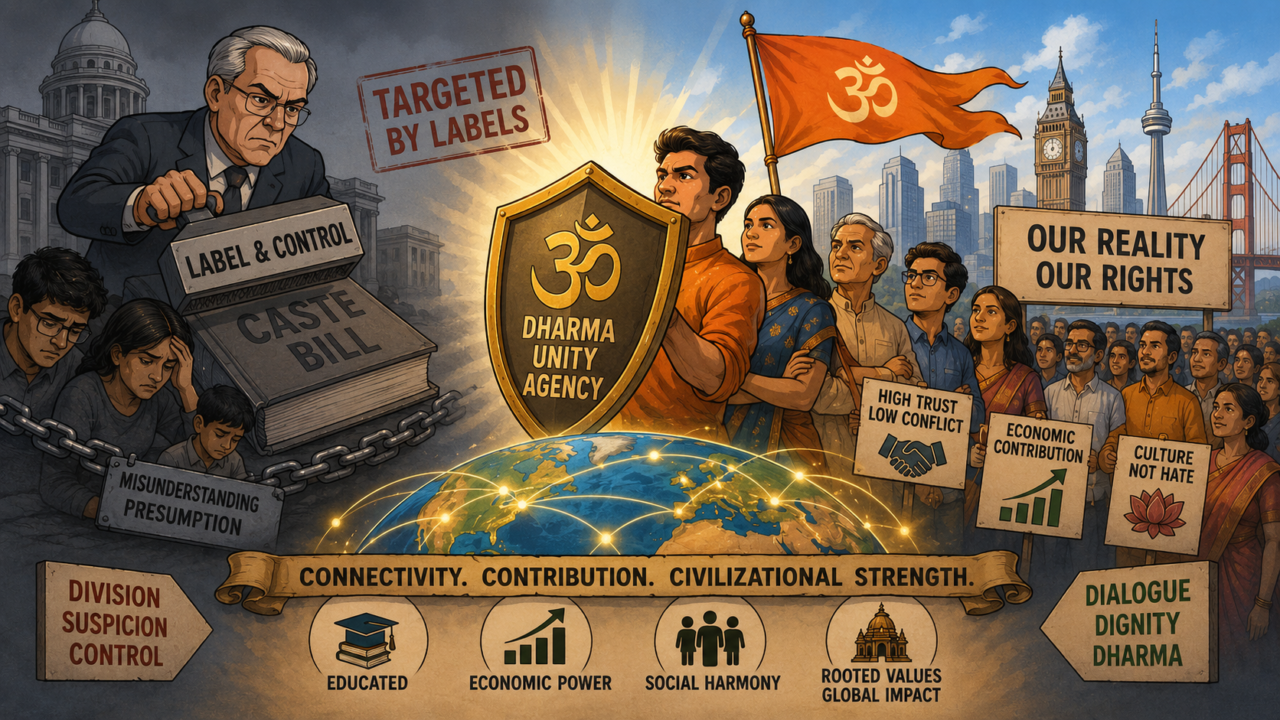
Across the skylines of Toronto, London, and Silicon Valley, a quiet but profound shift is occurring. For decades, the global Hindu diaspora was celebrated as the “model minority”—a demographic defined by high educational attainment, low crime rates, and significant economic contributions. However, a new trend is emerging in Western legislative corridors: a surge of policies that many argue target the very cultural DNA of this community.
This is no longer just a debate about traditions; it is a tug-of-law between institutional overreach and the fundamental right to live by an internal “social contract.”
1. The Numbers of a High-Trust Society
To understand the resistance, one must first look at the data of the community being legislated. According to the Indiaspora 2026 Report, the formal annual earnings of the Indian diaspora have reached approximately $730 billion. In the United States alone, while making up roughly 1% of the population, Hindu Americans contribute a disproportionately high percentage of the federal tax base.
This economic success isn’t accidental. It is the result of a societal structure built on interconnectedness. In many Western frameworks, the individual is an island. In the Dharmic view, the individual is a node in a vast network of responsibilities—to family, to ancestors, and to the future. When legislation seeks to “categorize” or “label” these internal community dynamics—such as the controversial “caste” bills in California or Seattle—it often ignores that these communities have the lowest rates of social friction and the highest rates of “high-trust” economic cooperation.
2. Legislative “Labels” vs. Living Realities
In 2024 and 2025, several Western jurisdictions introduced bills that specifically name “caste” as a protected category. On the surface, it sounds like progress. But for the average person on the ground, the data tells a different story.
Critics and researchers point out that:
- Redundancy: Existing civil rights laws in the US and UK already prohibit discrimination based on “ancestry” and “national origin.”
- The “Targeting” Effect: By singling out a specific community’s social history, these laws inadvertently create a “presumption of guilt.”
- Social Trends: A 2023 survey of South Asians in the US found that while social distinctions exist, they are rapidly dissolving in the diaspora, with inter-community marriages rising by nearly 40% in the second generation.
The resistance we see today—thousands of Hindu Americans marching or writing to governors—isn’t about defending “inequality.” It is a resistance against being institutionalized by a foreign lens. It is the community saying: “Our social contract works; do not break it to fix a problem the data shows is naturally fading.”
3. The Global Pivot: From Passive to Proactive
The “Global Hindu Resistance” is not an angry mob; it is a sophisticated, data-driven advocacy movement. From the Hindu American Foundation (HAF) to various grassroots coalitions in Canada and Australia, the strategy has shifted from silence to Intellectual Kshatriyahood (the defense of truth).
| Region | Primary Legislative Concern | Resistance Strategy |
| USA | State-level “Caste” bills | Legal challenges & voter education |
| UK | Curriculum misrepresentation | Academic collaboration & factual audits |
| Canada | Temple vandalism & safety | Community security networks & diplomatic pressure |
This shift is backed by a demographic reality. By 2026, the Hindu diaspora is no longer just a “migrant” population; it is a stakeholder population. With $138 billion in remittances flowing back to India annually, the diaspora has realized that its cultural security is tied to its global economic and political agency.
4. Conclusion: The Return to Natural Law
At its heart, the friction between Western legislation and Hindu resistance is a clash of philosophies. One side believes that society is managed through external policing and labels. The other side—rooted in Sanatan values—believes that society is managed through Dharma, an internal compass of ethics and mutual duty.
The resistance is a signal that the world’s oldest living civilization is no longer willing to be a “museum piece” for Western sociologists to dissect. It is a living, breathing solution to modern loneliness and social fragmentation. By standing up against legislative overreach, the global Hindu community isn’t just protecting its past; it is securing a future where “interconnectedness” remains the ultimate human superpower.