
The ‘Saffron Dawn’ in Bengal: Dismantling 50 Years of Anti-Sanatan State Machinery
A long-form political analysis on Bengal, civilizational identity, demographic shifts, and the 2026 mandate.
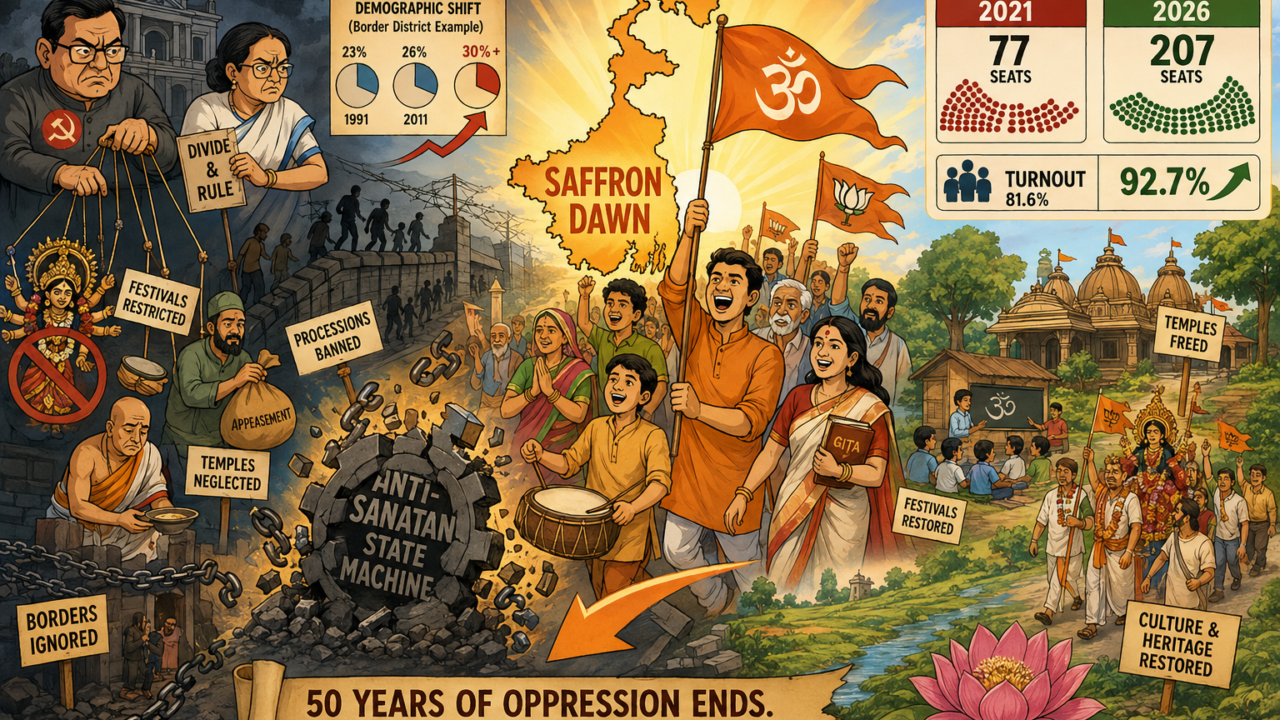
For more than half a century, the geographical and cultural landscape of West Bengal was treated as an ideological laboratory. First came three decades of institutionalized Left rule, followed by fifteen years of a hyper-polarized regime that thrived on fragmentation. For the average citizen, remaining rooted in traditional civilizational identity became an act of quiet resilience. However, the historic mandate of May 2026—which saw a monumental political shift with the challenger securing 207 out of 294 assembly seats—marks the official collapse of an artificial, state-sponsored machinery designed to suppress the region’s organic ethos.
This transformation is not merely a change in administrative leadership; it is the organic reclamation of an identity that had been systematically pushed to the margins.
The Demographics of Subversion: A 50-Year Overview
To understand the depth of this shift, one must examine the quiet, structural modifications that took place across Bengal’s border districts over several decades. Sociological and demographic studies reveal that the cultural equilibrium of the region was left completely unmonitored for political leverage.
The Baseline Shift: In 1951, the cultural demographic baseline of West Bengal stood firmly with an organic continuity that reflected its ancestral heritage. Over the next few decades, unchecked cross-border migration altered the social fabric entirely.
The Border District Transformation: Consider a critical border district like Cooch Behar. In 1991, the minority population stood at approximately 23.34%. By 2011, it crawled up to 25.54%. By early 2026, scientific assessments and local voter registration analysis indicated that this figure crossed the 30% threshold.
The Growth Disparity: Over a thirty-year trajectory, specific community growth rates in border areas outpaced the indigenous population by a ratio of nearly 1.7 to 1.
For decades, the state apparatus ignored these shifting realities. Instead of securing borders and protecting local land rights, successive administrations institutionalized a system where traditional festivals, temple processing rights, and cultural expressions were micro-managed, restricted, or entirely disallowed under the pretext of maintaining “communal harmony.”
The Strategy of Coerced Modernity
The machinery that ruled Bengal did not just rely on changing numbers; it relied on active psychological alienation. The state’s intellectual elite spent fifty years attempting to detach the land of Swami Vivekananda, Sri Aurobindo, and Chaitanya Mahaprabhu from its Vedic roots.
The strategy was subtle but aggressive:
- Iconographic Deception: Traditional celebrations were systematically secularized. The deeply spiritual essence of Durga Puja was often reduced by state-backed committees into purely commercial, artistic carnivals stripped of core Vedic rituals.
- The Persecution of Rituals: In rural pockets, administrative orders frequently blocked Ram Navami processions or Hanuman Chalisa recitations.
- Appeasement at the Cost of Heritage: Financial stipends were selectively granted to specific religious leaders from the state treasury, while ancient temple priests were left to survive on dwindling community donations.
The state tried to build a narrative that being modern and Bengali required completely discarding one’s Sanatan identity. But a nation’s core memory cannot be wiped away by administrative circulars.
The Math Behind the Awakening
The 2026 mandate succeeded because the silent majority realized that fragmented communities possess no political leverage. The political machinery that previously governed with a heavy hand was completely dismantled by a consolidated, conscious effort from the ground up.
| Political Metric | 2021 Realities | 2026 Mandate |
|---|---|---|
| Challenger Seat Share (Pro-Identity) | 77 Seats | 207 Seats |
| Incumbent Seat Share (Polarization-dependent) | 215 Seats | 80 Seats |
| Vote Share Shift | ~38% | 45.84% |
| Voter Turnout | 81.6% | 92.7% |
The staggering 92.7% voter turnout recorded across the state’s 6.8 crore electorate was not just an election; it was a civilizational referendum. In nine out of twenty-three districts, the previous regime failed to secure even a single seat. This absolute rejection demonstrates that the strategy of breaking society into artificial caste narratives to prevent a unified cultural stance has completely failed.
Restoring the Spiritual Equilibrium
The “Saffron Dawn” in Bengal is not a victory of aggression; it is a victory of restoration. It signifies the return of a landscape where the state machinery works with the cultural identity of its people, rather than actively working to suppress it.
The true triumph of this historic shift lies in the micro-level changes now taking place across rural blocks:
- The revival of village Pathshalas and Tol systems, or traditional schools.
- The removal of administrative blockades on ancestral festival routes.
- The return of local autonomy to ancient temples, freeing them from heavy-handed bureaucratic interference.
Bengal has proven that while political regimes can distort historical realities for a few decades, the eternal truth of the land—its Sanatan nature—will always find a way to break through the concrete of ideological oppression and bloom once again.