Tamil Nadu’s Fractured Mandate: Will TVK’s Rise Dilute or Deepen Dravidian Anti-Hinduism?
Despite decades of administrative attempts to weaken the spiritual fabric of Tamil Nadu through state control of over 44,000 temples via the Hindu Religious and Charitable Endowments (HR&CE) department, the actual cultural ground reality tells a different story.
For nearly six decades, the political and cultural narrative of Tamil Nadu was governed by an absolute, impenetrable duopoly. The alternating regimes of the Dravida Munnetra Kazhagam (DMK) and the All India Anna Dravida Munnetra Kazhagam (AIADMK) did not just share administrative power; they shared a foundational philosophy. This philosophy, built on the tenets of early 20th-century Dravidian ideology, frequently positioned itself in direct opposition to the civilizational, spiritual, and Vedic identity of the land—often labeling the state’s deep-rooted ancestral traditions as “external impositions.”
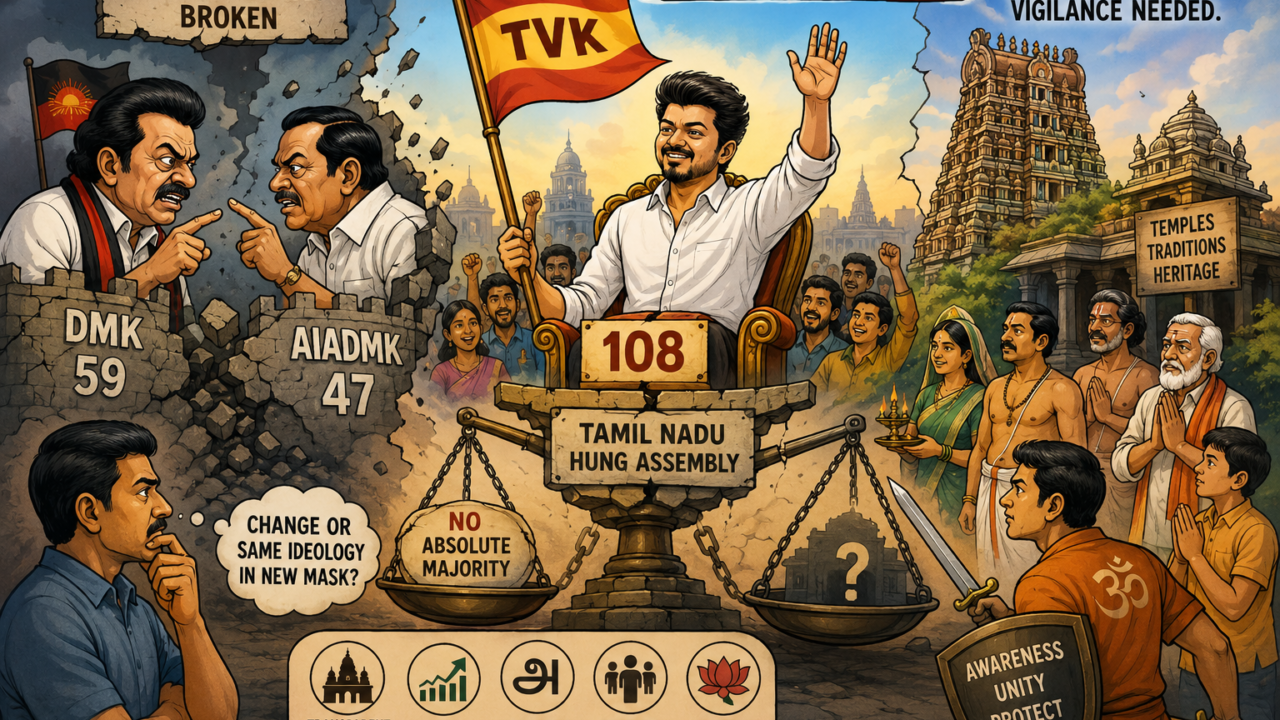
However, the historic legislative assembly election of May 2026 has entirely shattered this bipolar axis. The sudden emergence of the Tamilaga Vettri Kazhagam (TVK), led by actor-turned-politician C. Joseph Vijay, has resulted in the state’s first true hung assembly, with TVK claiming 108 seats.
As the dust settles on this fractured mandate, society faces a critical question: Does this political disruption signal a dilution of the aggressive anti-Sanatan rhetoric that has dominated the state, or will it merely introduce a more refined, decentralized version of the same ideological warfare?
The Anatomy of a Disruption: The 2026 Numbers
The scale of the shift in Tamil Nadu’s political landscape is visible in the raw metrics of the 2026 election. For the first time since the 1960s, a new political entity has pushed both traditional giants into a defensive position.
| Political Entity | 2021 Tally | 2026 Mandate Tally | Shift in Representation |
| TVK (New Aspirant) | — | 108 Seats | Emerged as Single Largest Party |
| DMK (Incumbent Axis) | 133 Seats | 59 Seats | Outgoing CM Lost Local Constituency |
| AIADMK (Traditional Opposition) | 66 Seats | 47 Seats | Fractured; Internal Rebellion |
| National Identity Alignments (BJP) | 4 Seats | 1 Seat | Maintained minimal direct assembly footprint |
The state recorded an unprecedented 85.1% voter turnout, the highest in its democratic history. This indicates that the mandate was not a product of voter apathy, but a deliberate, massive intervention by the public. The complete collapse of the incumbent DMK axis—dropping from a dominant position to just 59 seats—reflects a deep, underlying societal fatigue with institutional corruption, dynastic entitlement, and repetitive ideological posturing.
The Ideological Mask: Secularism vs. Subversion
To determine whether TVK will deepen or dilute anti-spiritual sentiment, one must examine its foundational core. During its initial public conferences, the TVK leadership explicitly adopted a center-left platform, naming Periyar E.V. Ramasamy as one of its key ideological pillars alongside B.R. Ambedkar and K. Kamaraj.
By adopting the symbol of Periyar—the father of the self-respect movement who famously advocated for the eradication of traditional Vedic rituals—TVK has signaled to the old Dravidian voter base that it does not intend to abandon the core tenets of regional identity. This continuity became evident immediately after the elections, when newly elected TVK representatives openly stated in public forums that their entry into politics was explicitly to challenge and dismantle “Sanatan frameworks”.
However, the strategy differs fundamentally from the DMK’s historical approach in two distinct ways:
- The Shift to Co-Option over Confrontation: Unlike the older generation of politicians who relied on aggressive, overt attacks on temple practices to mobilize their base, the new wave of politics seeks to separate culture from faith. By focusing heavily on Tamil nationalism and regional pride, the narrative attempts to absorb local village deities, ancestral worship, and indigenous literature, while cutting their connection to the broader, pan-Indian Vedic architecture.
- The “Secular Social Justice” Shield: TVK uses modern, corporate-friendly jargon—focusing on “egalitarianism” and “good governance”—to appeal to younger, urban voters who are fatigued by the crude anti-religious rhetoric of the past. This approach makes the underlying ideological shift more palatable to a generation that might otherwise reject direct attacks on their heritage.
The Silent Defense of the Sacred Land
Despite decades of administrative attempts to weaken the spiritual fabric of Tamil Nadu through state control of over 44,000 temples via the Hindu Religious and Charitable Endowments (HR&CE) department, the actual cultural ground reality tells a different story.
The mandate of 2026 is a reflection of a society seeking a change in how it is governed, but it is also caught in a complex balancing act. The state’s ancient temples, its classical carnatic traditions, and its daily public life remain profoundly anchored in the sacred geography of Sanatan Dharma. The political machinery has broken the bipolar duopoly because citizens demand accountability, transparent temple management, and an end to asset mismanagement.
The national leadership has quietly shifted the focus of the state’s discourse. By consistently highlighting the economic potential of the spiritual tourism corridor and pushing for institutional transparency, the conversation in Tamil Nadu has slowly transitioned from whether traditions should exist to how they should be preserved and protected from state exploitation.
The Path Ahead: A Civilizational Vigilance
The “Fractured Mandate” of May 2026 proves that the old political order can be dismantled when a society decides to move past dynastic stagnation. However, for those who value the eternal, uninterrupted spiritual heritage of the South, the rise of TVK is not a signal to relax.
While the overt, aggressive hostility of the previous regime has been reduced due to its severe electoral defeat, the underlying effort to distance Tamil Nadu from its civilizational roots has simply evolved into a newer, more modern political language. The survival and ultimate revival of the region’s true identity will depend not on political shifts in the assembly, but on the continuous, decentralized awareness of the community to protect its temples, its traditions, and its history from being used as chips in political games.