
Khatu’s Forgotten Temples: What the Ruins of Shahi Masjid Reveal About a Lost Chapter of Bharat’s History
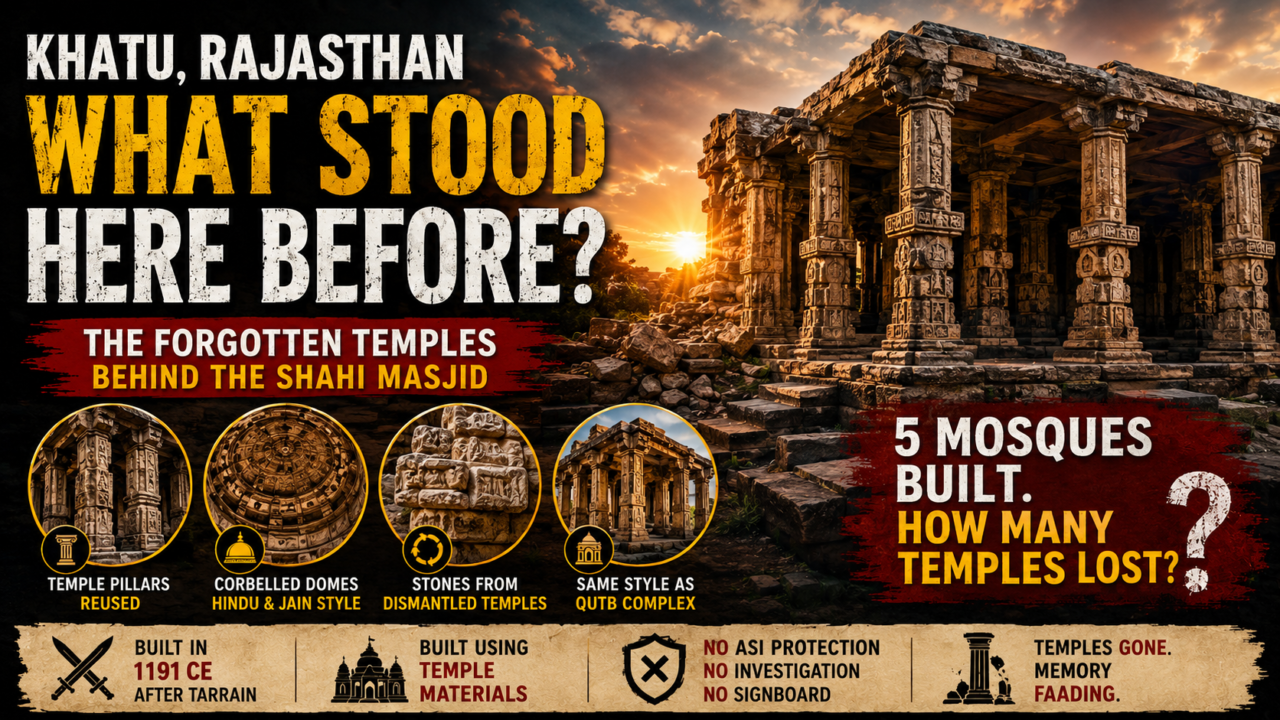
Hidden in the historic town of Khatu, Rajasthan, stands a little-known monument that continues to raise difficult questions about India's medieval past. The Shahi Masjid of Khatu, believed by several researchers to incorporate architectural elements from earlier Hindu and Jain temples, preserves clues carved into its pillars, domes, and stonework. As the original temples fade from public memory, the site invites us to ask: What once stood here, who built it, and why has this chapter of history remained largely forgotten? Through architecture, inscriptions, and historical context, Khatu's silent stones tell a story that deserves deeper exploration.
Introduction
Across Bharat stand hundreds of monuments whose stones tell stories very different from the signboards placed beside them. Some are celebrated, some are protected, and some are quietly forgotten.
In the town of Khatu in Rajasthan, known today primarily for the revered Khatu Shyam Ji temple, lies a lesser-known structure known as the Shahi Masjid of Khatu. Weathered by time and largely ignored by mainstream discourse, this monument raises questions that historians, archaeologists, and heritage enthusiasts have debated for decades.
Was this structure built upon the remains of earlier Hindu and Jain temples? What do its pillars, carvings, and inscriptions reveal? And why has this chapter of history remained outside public discussion?
Khatu: More Than a Village
Medieval Khatu was not merely a small settlement. Historical records place it on an important route connecting regions such as Multan and Bayana, making it a significant center for merchants, pilgrims, and travelers.
The region was home to thriving religious and commercial activity. Hindu and Jain communities established temples, dharmashalas, and sacred spaces that served travelers moving across northern Bharat.
Many local traditions also associate the area with fortifications dating back to the era of Prithviraj Chauhan, reflecting the strategic importance of the region before the Ghurid invasions of the late twelfth century.
The Turning Point: 1191–1192 CE
The closing years of the twelfth century marked one of the most consequential periods in Indian history.
The Second Battle of Tarain (1192 CE) resulted in the defeat of Prithviraj Chauhan by Muhammad Ghori. Following this victory, Ghurid authority expanded rapidly across large parts of northern India.
It was during this period that several early mosques emerged in newly conquered territories. Historians have long noted that many of these structures incorporated architectural elements taken from pre-existing Hindu and Jain temples.
Khatu is often cited among these early examples.
What the Architecture Suggests
One of the strongest arguments presented by researchers studying the site comes not from chronicles or legends, but from the structure itself.
Visible Temple Features
Visitors to the monument can still observe several characteristics commonly associated with temple architecture:
- Rows of carved stone pillars arranged in a style typical of Hindu and Jain mandapas.
- Corbelled dome construction techniques seen in medieval temple traditions.
- Decorative carvings and sculptural motifs that predate Islamic architectural styles in the region.
- Reused column segments and architectural fragments integrated into later construction.
The arrangement bears similarities to other medieval structures where temple materials were reused during mosque construction, including sites associated with the early Delhi Sultanate period.
For many researchers, these elements suggest that substantial portions of the monument originated from earlier sacred structures.
The Evidence of Inscriptions
Historical discussions surrounding the monument frequently reference inscriptions associated with the structure.
According to researchers who have examined these inscriptions, the mosque is generally dated to the period immediately following the Ghurid conquest of northern India in the late twelfth century.
Additional inscriptions indicate later restoration work during the Mughal period, particularly under Emperor Akbar.
While these inscriptions help establish phases of construction and restoration, they do not fully resolve the question of what stood at the site before the mosque was built. That debate continues among historians and heritage scholars.
A Pattern Seen Elsewhere
Khatu is not the only monument where questions of architectural reuse arise.
Across northern India, several early Sultanate-era structures contain pillars, lintels, and carved stones identifiable as products of Hindu and Jain craftsmanship.
Archaeologists generally agree that reused building material—often called spolia—was employed in a number of medieval constructions. The extent, context, and interpretation of such reuse, however, remain subjects of academic debate.
Khatu therefore forms part of a broader conversation about how political conquest, religious transformation, and architectural adaptation shaped medieval India.
The Forgotten Heritage
What makes Khatu unusual is not only the structure itself but the relative lack of public attention it receives.
Unlike more famous disputed heritage sites, the Shahi Masjid of Khatu has not become the focus of major national discussions. Portions of the monument have deteriorated over time, and many visitors remain unaware of the historical questions associated with it.
As the structure ages, an important concern emerges:
If earlier temples once stood here, where are their stories preserved today?
The physical remains may survive in pillars and stones, but the memory of the communities that built them risks disappearing altogether.
Questions That Deserve Research
Rather than approaching the site through emotion or political rhetoric, serious historical inquiry requires evidence-based investigation.
Among the questions worthy of deeper study are:
- What temples existed in medieval Khatu before the twelfth century?
- Which architectural elements can be conclusively identified as temple remains?
- What do inscriptions reveal about successive phases of construction?
- How extensive was the reuse of earlier sacred structures?
- Can archaeological surveys provide a clearer reconstruction of the site’s past?
These questions are best answered through rigorous scholarship, documentation, and preservation efforts.
Why It Matters Today
Civilizations are remembered not only through what survives, but also through what is forgotten.
The story of Khatu is larger than one monument. It reflects the broader challenge of understanding Bharat’s complex past—its achievements, conflicts, transformations, and cultural continuity.
Recognizing historical evidence, preserving architectural remains, and encouraging open academic investigation are essential steps toward ensuring that future generations inherit a complete understanding of their heritage.
Whether one views Khatu as a symbol of conquest, adaptation, loss, or continuity, its stones continue to ask a simple question:
What stood here before?
And until that question is fully explored, Khatu’s silent pillars will remain among the most intriguing witnesses to a forgotten chapter of Bharat’s civilizational history.
Dharma Kavach Editorial Note
Dharma Kavach supports the preservation and study of all heritage sites through lawful, scholarly, and evidence-based inquiry. Historical claims should be evaluated through archaeology, inscriptions, primary sources, and academic research rather than through speculation or communal hostility. Understanding history strengthens civilization; destroying heritage weakens it.