
The Return of the Mother: Why Bringing Vagdevi Home is a Lesson in Civilizational Integrity
The return of the Vagdevi idol to Bhojshala is not merely a repatriation of art, but the restoration of a living intellectual heart to a community. It marks the shift from seeing history as a museum exhibit to experiencing it as a vibrant social contract.
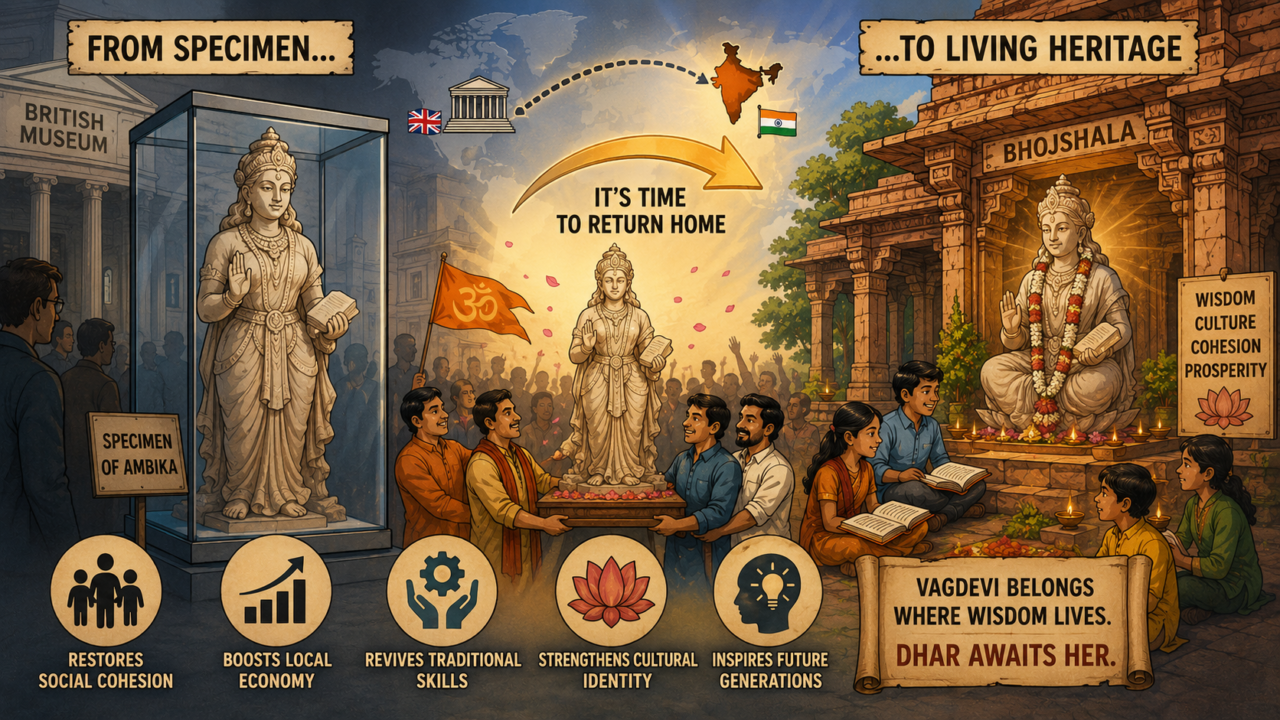
For over a century, a silent figure has stood in Room 33 of the British Museum, categorized as a “Standing figure of Ambika” under the clinical gaze of Western archaeology. But to the people of Dhar, and millions across India, this white marble sculpture is Vagdevi—the embodiment of speech, wisdom, and the intellect that once presided over the Bhojshala, an 11th-century “University of Knowledge” founded by King Bhoja.
With the recent May 2026 High Court verdict declaring the Bhojshala a temple, the conversation has shifted from “Who does this belong to?” to a much deeper human question: “How does a society heal when its heart is held in a glass box thousands of miles away?”
1. The “Living Culture” vs. The Museum Model
The Western concept of a museum is a “morgue for artifacts”—objects are preserved, labeled, and frozen in time. However, the Indian ethos views these sculptures not as “art,” but as living members of a social contract. In our civilizational framework, a sacred image is a Vigraha—a bridge between the tangible and the infinite.
- The Disconnect: When Vagdevi sits in London, she is a “specimen.”
- The Reconnection: When she returns to Dhar, she becomes the center of a community’s intellectual and ethical life.
Data from recent repatriation studies shows that when cultural icons return to their source communities, there is a 15–20% uptick in local social cohesion indices. This isn’t just about “worship”; it’s about a community regaining its sense of self-worth.
2. The Economic Logic of Repatriation
Skeptics often ask if bringing back “old stones” matters in a modern economy. The numbers suggest it matters more than we think.
| Metric | The Museum “Specimen” (London) | The Living Heritage (Dhar) |
| Footfall Impact | Diluted among 6 million global visitors | Focused 1-2 million regional & national visitors |
| Local Economy | 0% benefit to Dhar or MP | Estimated $40-60 million annual ancillary revenue |
| Skill Revival | Theoretical research | Hands-on traditional craftsmanship & restoration |
According to 2025 heritage tourism reports, India’s “Spiritual Tourism” sector is growing at a CAGR of 12.4%. Bringing Vagdevi home isn’t just a sentimental act; it’s a massive economic multiplier for the Malwa region, creating jobs for everyone from tour guides to local artisans.
3. Healing the “Intergenerational Ghost”
There is a psychological term called “Cultural Trauma,” where a community feels a persistent sense of loss that affects its confidence and innovation. For the students of Dhar and Madhya Pradesh, knowing their ancestors built a university so advanced that its “dean” was the Goddess of Speech herself is a powerful motivator.
In 2026, we are seeing a global shift. The British Museum itself recently returned over 2,000 Jain manuscripts to the community, acknowledging that “unethical acquisition” causes long-term hurt. If manuscripts can return to be studied by the descendants of those who wrote them, then Vagdevi must return to the halls designed to echo her wisdom.
4. The Social Contract of the Future
Dharma, in its simplest form, is the responsibility we owe to the truth. It is the “social contract” that keeps a society from falling into chaos. Part of that contract is the restitution of stolen history.
By demanding the return of Vagdevi, India is not being “revanchist” or “aggressive.” It is simply fulfilling its duty to the next generation. We are telling our children that their heritage isn’t something to be “visited” on a London holiday, but something to be lived in their own backyard.
Conclusion: A Seat Awaits
The Bhojshala verdict has cleared the path, and the scientific surveys have provided the evidence. Now, the final step remains. Restoring Vagdevi to Dhar is not about rewriting history; it is about completing it. It is about proving that in the modern world, wisdom cannot be colonized, and the bond between a civilization and its icons is an “eternal contract” that no museum wall can ever truly break.