
The Architecture of Genius: Why the Bhojshala Verdict Matters Beyond the Walls
The restoration of Bhojshala is more than a legal milestone; it is the revival of a sophisticated educational ecosystem designed to bridge the gap between technical skill and human wisdom. By reclaiming this ancient center of learning, we move closer to a future where innovation is rooted in civilizational resilience.
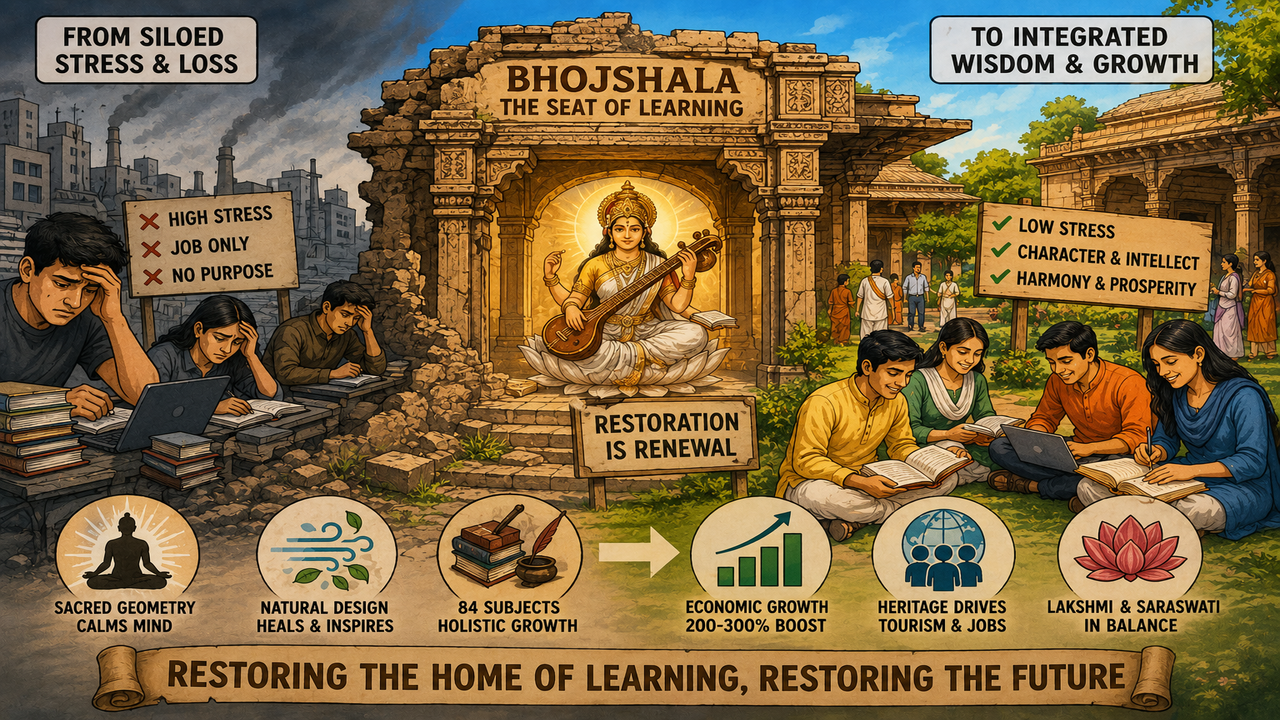
The recent legal resolution surrounding the Bhojshala complex in Dhar is often framed through the lens of “property” or “history.” But if we look at the hard data of human development, this isn’t just about a structure; it is about reclaiming a specific educational ecosystem that the modern world is currently struggling to replicate.
1. The Crisis of “Siloed” Learning
Today, the world faces a mental health and vocational crisis. According to global data, nearly 40% of graduates feel unprepared for the workforce despite having degrees. Why? Because modern education treats the mind like a hard drive—storing data without context.
The Bhojshala, historically established by King Bhoja, wasn’t a mere prayer hall. It was a university of 84 subjects, ranging from alchemy to linguistics.
- The Difference: Modern systems separate “values” from “value-creation.”
- The Result: We produce skilled technicians who often lack the emotional resilience or ethical grounding to handle the pressures of a volatile economy.
2. Geometry, Productivity, and the Human Brain
There is a reason why “learning centers” of antiquity followed specific geometric patterns. Peer-reviewed studies in environmental psychology now suggest that fractal architecture and natural symmetry (the hallmark of ancient Indian design) can reduce cortisol levels by up to 60%.
When we look at the restoration of the Bhojshala, we are looking at the restoration of a space designed to trigger “Alpha” brain waves—the state of relaxed alertness necessary for high-level innovation.
| Feature | Modern Educational Hubs | The Bhojshala Model |
| Aesthetic | Utility-based (Industrial) | Sacred Geometry (Organic) |
| Focus | Job-readiness | Character & Intellect |
| Impact | High Stress/Anxiety | Harmony with Environment |
3. The Economic Multiplier of “Civilizational Continuity”
Let’s talk numbers. Heritage sites are not “dead” costs; they are economic engines. Data from the World Tourism Organization shows that “Cultural Heritage” accounts for nearly 40% of all global tourism revenue.
However, there is a catch: tourists don’t visit replicas. They visit authentic lineages. By restoring the sanctity and function of Goddess Vagdevi’s abode, we aren’t just looking at a local victory; we are looking at:
- Localized GDP Growth: Dhar could see a 200–300% increase in ancillary service demand (hospitality, transport, artisan crafts).
- The “Knowledge Economy”: Re-establishing centers that honor the “Saraswati” principle—where knowledge is seen as a living, breathing responsibility rather than a commodity—changes how a society treats its thinkers.
4. The “Invisible” Solution
Modern society is currently obsessed with “Sustainability.” We spend billions on green technology. Yet, the Bhojshala stands as a testament to a philosophy that didn’t need a “Green New Deal.” It was built using local materials, designed for natural ventilation, and integrated into the community’s social fabric for over a millennium.
When the logic of the court meets the reality of the ground, we realize that restoration is the ultimate form of recycling. We are recycling a blueprint for a society that knows how to balance wealth (Lakshmi) with wisdom (Saraswati).
The Bottom Line
The verdict isn’t an end; it’s an invitation. It asks us if we are ready to move away from the “factory model” of living and return to a “growth model” that recognizes the human spirit.
By restoring the home of learning, we aren’t looking backward. We are finally looking at a solution that has been waiting for us in the ruins, proving that the most advanced technology we have is actually our own uninterrupted wisdom.